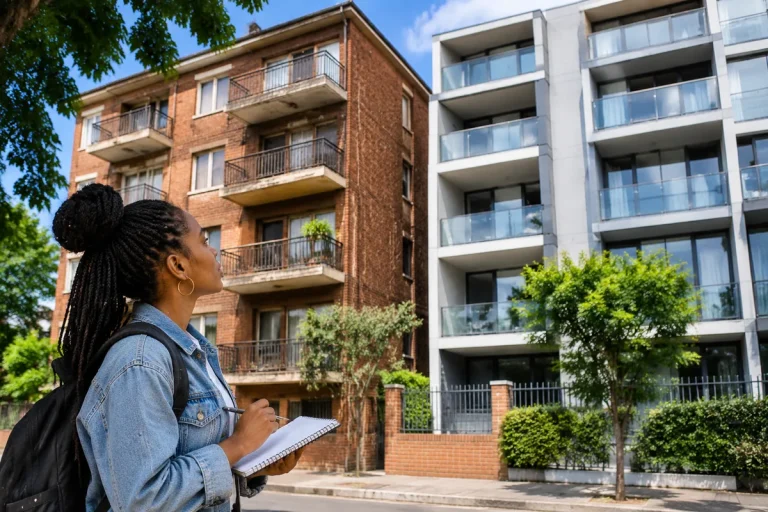
Learning to compare apartment locations fairly helps you avoid a costly mistake. Apartment location affects much more than the view from your window. It influences commuting time, transportation cost, access to services, parking, noise, social life, and how easy everyday tasks feel.
This guide gives you a simple way to compare apartment locations on commute, safety, noise, cost and daily convenience.
When two apartments have similar rent, the better location is not necessarily the more fashionable neighborhood. It is the one that fits your real routine at a sustainable total cost.
Map Your Weekly Routine
List the places you regularly need to reach: work, school, childcare, grocery stores, healthcare, family, public transportation, and other important commitments.
Place them on a map and compare travel times from each apartment candidate.
This is more useful than comparing straight-line distance.
Check Commute Time at Realistic Hours
Traffic and public transportation can change dramatically during peak periods. Test routes during the times you expect to travel.
For public transit, check walking distance, transfer count, service frequency, and weekend or evening schedules.
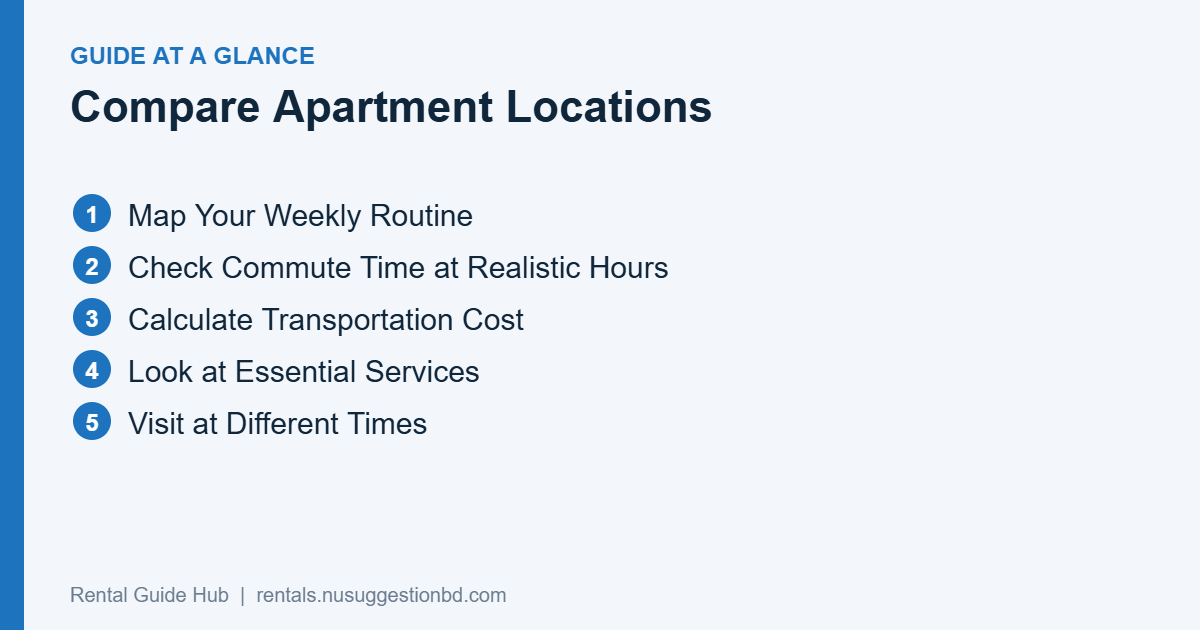
Calculate Transportation Cost
A lower rent can be offset by fuel, parking, tolls, public transit, vehicle maintenance, or ride-share spending.
Combine transportation with rent when comparing neighborhoods. Our guide Rent vs. Income: How Much Rent Can You Realistically Afford? helps place these costs into a complete monthly budget.
Look at Essential Services
Check access to groceries, pharmacies, healthcare, banking, schools, parks, laundry, and other services you expect to use.
An area with fewer nearby services may require more driving or delivery costs.
Visit at Different Times
A street that feels quiet during a weekday afternoon may be noisy at night. Parking conditions, traffic, lighting, and business activity can change.
If possible, visit morning, evening, and weekend.
Use Reliable Safety Information
Safety is complex and should not be reduced to a single rating. Look at official local crime data where available, street lighting, building access, pedestrian conditions, emergency services, and your actual travel patterns.
Avoid making decisions based only on anonymous neighborhood comments.
Compare Building Security
Location and building design work together. Ask about entry systems, lighting, locks, package areas, parking access, and maintenance.
A well-managed building can matter as much as the broader neighborhood.
Consider Noise Sources
Map nearby highways, nightlife areas, schools, hospitals, airports, railways, construction sites, and commercial facilities.
Listen from inside the unit with windows open and closed.
Check Parking Before You Need It
If you own a car, ask whether parking is assigned, permit-based, street-only, or separately rented. Visit during the evening when spaces may be limited.
If you rely on guests, understand visitor parking rules.
Think About Walkability for Your Needs
A high walkability score does not automatically mean the area works for you. Consider the specific destinations you use.
Someone who walks to transit has different needs from someone who carries groceries for a family.
Look at Future Changes
Major construction, new transit, road projects, or redevelopment can affect noise, travel, and neighborhood services.
Official city planning sources may provide useful context.
Compare Rent With Similar Nearby Areas
Search a few adjacent neighborhoods rather than focusing on one famous area. A short distance can create a meaningful rent difference while preserving transportation access.
See How to Find Affordable Apartments Without Sacrificing Safety for a structured affordability comparison.
Consider Distance From Friends and Support
Moving far from your normal support network can create hidden costs in time and transportation.
This is especially important for families, caregivers, and people who rely on relatives or friends for regular help.
Check Mobile and Internet Coverage
Remote workers and students should verify internet providers at the exact address and test mobile service during a visit.
Do not assume neighboring buildings have identical options.
Understand Local Rules and Services
Parking permits, trash collection, snow removal, school enrollment, recycling, and other services may vary by location.
Use official city or local government sources for current rules.
If You Are New to the City
Relocation creates additional uncertainty. Read Questions to Ask Before Renting an Apartment in a New City for a broader checklist before signing.
For U.S. renters looking for public housing and rental resources, see https://www.usa.gov/rental-housing.
Official Resources for Compare Apartment Locations
- U.S. Census Bureau: QuickFacts
- Walk Score: Walkability and transit information
- FBI Crime Data Explorer
More Guides Related to Compare Apartment Locations
- How to Choose an Apartment Near Public Transportation
- City Apartment vs Suburban Apartment: Best Choice in 2026
- How to Compare Apartment Buildings in the Same Neighborhood
Compare Apartment Locations at a Glance
To compare apartment locations well, test commute, noise and safety yourself at different times of day. Use the same scoring whenever you compare apartment locations.
Frequently Asked Questions About Compare Apartment Locations
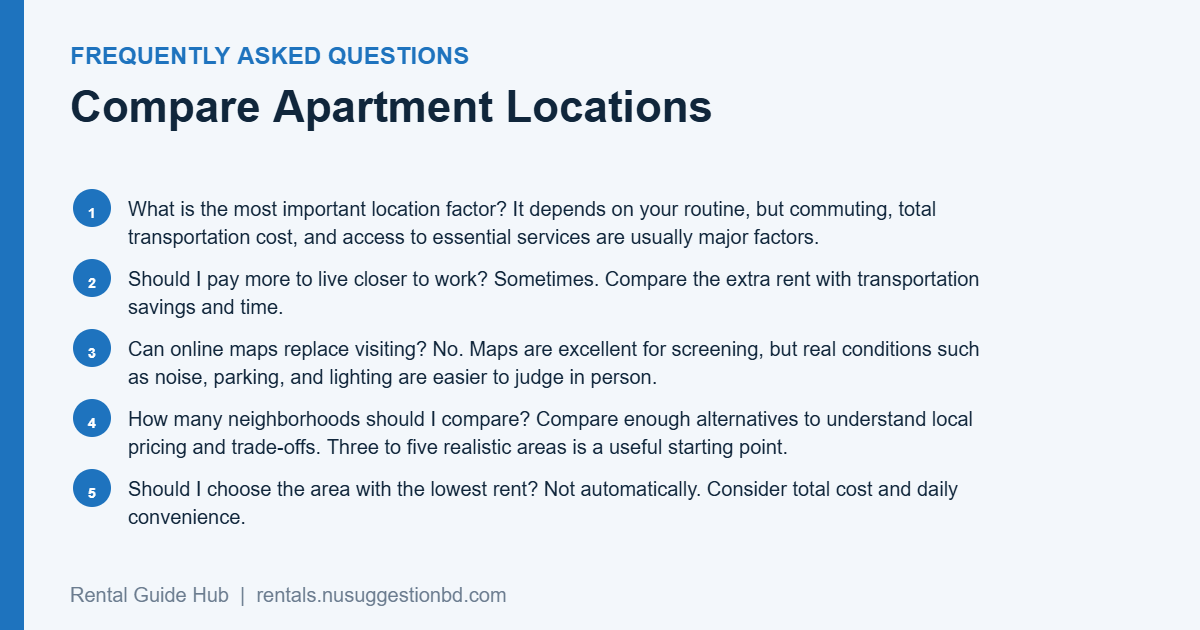
What is the most important location factor?
It depends on your routine, but commuting, total transportation cost, and access to essential services are usually major factors.
Should I pay more to live closer to work?
Sometimes. Compare the extra rent with transportation savings and time.
Can online maps replace visiting?
No. Maps are excellent for screening, but real conditions such as noise, parking, and lighting are easier to judge in person.
How many neighborhoods should I compare?
Compare enough alternatives to understand local pricing and trade-offs. Three to five realistic areas is a useful starting point.
Should I choose the area with the lowest rent?
Not automatically. Consider total cost and daily convenience.
Where should I start with compare apartment locations?
Start with the section on “Map Your Weekly Routine”, then move on to “Check Commute Time at Realistic Hours” and keep short notes as you work through this compare apartment locations guide.
Final Verdict on Compare Apartment Locations
Apartment location is a financial and lifestyle decision. Compare real commute times, transportation costs, services, parking, noise, and neighborhood conditions instead of relying on reputation alone. The best location is the one that supports your daily life without stretching your budget. Keep this compare apartment locations guide handy as a checklist the next time you compare options.