Affordable rent depends on far more than a percentage of your income. A common rental question is simple to ask but harder to answer: how much rent can I afford? The right number depends on much more than a percentage of income. Two people with the same salary can have very different budgets because of transportation, debt, dependents, healthcare costs, savings goals, and local utility prices.
This guide helps you set affordable rent for your income by counting every monthly cost, not only the listed price.

A useful rent target should let you pay housing costs consistently, cover necessary expenses, and still have some margin for emergencies. Instead of treating a single rule as universal, build a budget around your actual cash flow.
Start With Monthly Take-Home Income
Gross income is useful for applications, but your day-to-day budget depends on the money that reaches your bank account after taxes and payroll deductions. Use your typical monthly take-home income as the starting point.
If your income varies, such as freelance, commission, seasonal, or hourly work, use a conservative average. Looking at several months of income is usually better than budgeting around your best month.
Understand the 30 Percent Guideline
You may hear that rent should be around 30 percent of income. This can be a useful reference point, but it is not a universal rule. It does not automatically account for taxes, debt, location, transportation, childcare, healthcare, or savings.
In expensive housing markets, many renters spend more than 30 percent. In lower-cost areas, some renters choose to spend less to reach other financial goals faster.
Treat the percentage as a comparison tool, not permission to ignore your actual expenses.
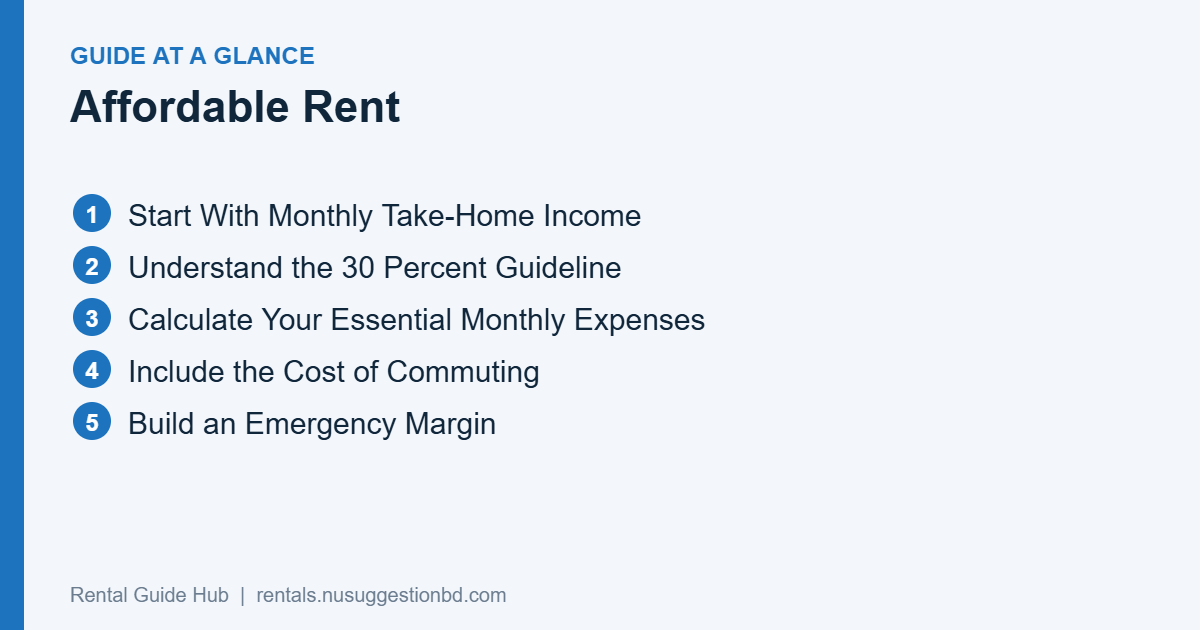
Calculate Your Essential Monthly Expenses
List fixed and necessary expenses before deciding on rent. Typical categories include food, transportation, debt payments, insurance, phone, internet, childcare, medical costs, subscriptions you genuinely use, and minimum savings.
Then estimate housing costs beyond rent, such as electricity, gas, water, trash, parking, renter’s insurance, laundry, and pet fees.
If the remaining amount after these expenses is too small for normal discretionary spending and unexpected costs, the rent target is probably too high.
Include the Cost of Commuting
A cheaper apartment farther from work can look attractive until transportation is added. Compare fuel, public transit, parking, tolls, vehicle wear, and commuting time.
For some renters, paying slightly more to live near work or transit reduces total monthly costs. This is why our guide on How to Find Affordable Apartments Without Sacrificing Safety recommends comparing the entire cost of living in a property rather than rent alone.
Build an Emergency Margin
A budget that works only when nothing goes wrong is fragile. Even a small emergency fund can protect you from using high-interest debt for medical bills, car repairs, temporary income loss, or urgent travel.
Before committing to the highest rent you technically qualify for, ask whether you would still manage if your monthly expenses rose unexpectedly.
Estimate Utilities Before Signing
Utilities can vary by building size, energy efficiency, climate, and which services are included. Ask the landlord which utilities are included and which are separately metered.
If possible, request a typical range rather than assuming a fixed number. Older units with poor insulation or inefficient heating and cooling may have lower rent but higher utility costs.
Consider Your Current Debt
Minimum debt payments reduce the amount available for housing. Credit cards, student loans, personal loans, car payments, and other obligations should be included in your monthly budget.
If you are aggressively paying down high-interest debt, you may intentionally choose a lower rent than a landlord’s income requirement would allow.
Think About Savings Goals
Your rent should not automatically consume every dollar left after bills. Consider whether you are saving for emergencies, education, travel, retirement, a vehicle, a home purchase, or business goals.
A slightly less expensive apartment can create meaningful long-term flexibility.
Do Not Forget Move-In Costs
Affording the monthly rent does not mean you can comfortably cover the move. Initial costs may include an application fee, security deposit, first month’s rent, utility deposits, movers, transportation, furnishings, and household supplies.
Plan these costs before applying. Our Rental Application Guide: Documents, Fees, and Approval Steps explains one of the largest common upfront expenses.
A Simple Rent-Affordability Method
Try this practical process:
Calculate conservative monthly take-home income.
Subtract all fixed debt and essential expenses.
Subtract realistic transportation and utility estimates.
Set aside a regular savings amount.
Leave a buffer for variable spending and emergencies.
The remaining amount creates a realistic ceiling for housing, not necessarily a target to spend in full.
If the result feels too tight, lower the rent target or change another major expense.
Example Budget
Imagine a renter brings home $4,000 per month. After debt, transportation, insurance, food, phone, savings, and other necessary expenses, $1,700 remains for housing and flexible spending.
Choosing a $1,650 apartment before utilities would leave almost no cushion. A $1,250 to $1,400 unit might create a healthier margin depending on local costs.
The exact numbers are less important than the method: use the money you actually have and include the expenses you actually pay.
What Landlords May Look At
Landlords and property managers may use income requirements, credit history, rental history, background checks, references, guarantors, or other criteria where allowed by law. Qualification standards vary by property and location.
Do not confuse approval with affordability. A landlord may approve a rent amount that is uncomfortable for your personal budget.
For general U.S. housing information, visit https://www.usa.gov/rental-housing.
Lowering Your Housing Cost
If your preferred apartment exceeds your budget, you may have several options. You can compare nearby neighborhoods, choose a smaller unit, live with a roommate where appropriate, negotiate included services, reduce optional amenities, or delay a move until you have a larger financial cushion.
Moving itself can be expensive. Our guide on How to Move on a Budget: Practical Ways to Cut Moving Costs can help reduce one-time costs without creating unnecessary risk.
Official Resources for Affordable Rent
- Consumer Financial Protection Bureau: Budgeting and money tools
- HUD: Tenant rights, laws and protections
- U.S. Census Bureau: QuickFacts
More Guides Related to Affordable Rent
- How to Find Affordable Apartments Without Sacrificing Safety
- Apartment Utility Costs: What Renters Should Budget For
- Negotiate Rent in 2026: Smart Tips That Actually Work
Affordable Rent at a Glance
Affordable rent is the amount you can pay while still covering savings and other bills. Recalculate affordable rent whenever your income or costs change.
Related reading: Rent and debt budget and Student rent budget.
Frequently Asked Questions About Affordable Rent
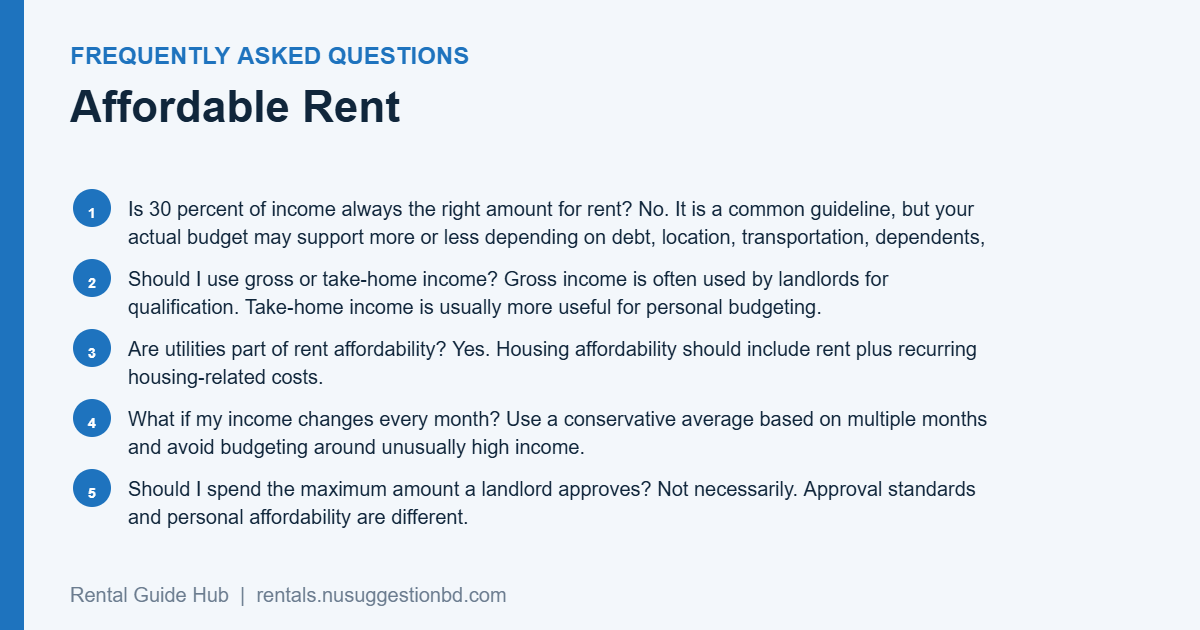
Is 30 percent of income always the right amount for rent?
No. It is a common guideline, but your actual budget may support more or less depending on debt, location, transportation, dependents, and savings goals.
Should I use gross or take-home income?
Gross income is often used by landlords for qualification. Take-home income is usually more useful for personal budgeting.
Are utilities part of rent affordability?
Yes. Housing affordability should include rent plus recurring housing-related costs.
What if my income changes every month?
Use a conservative average based on multiple months and avoid budgeting around unusually high income.
Should I spend the maximum amount a landlord approves?
Not necessarily. Approval standards and personal affordability are different.
Where should I start with affordable rent?
Start with the section on “Start With Monthly Take-Home Income”, then move on to “Understand the 30 Percent Guideline” and keep short notes as you work through this affordable rent guide.
Final Verdict on Affordable Rent
A realistic rent budget is based on your complete financial picture, not a single percentage. Use take-home income, account for debt and utilities, protect your savings, and keep a buffer for unexpected costs. The best rent target is one that lets you live comfortably after the payment is made, not one that leaves your budget at zero. Keep this affordable rent guide handy as a checklist the next time you compare options.