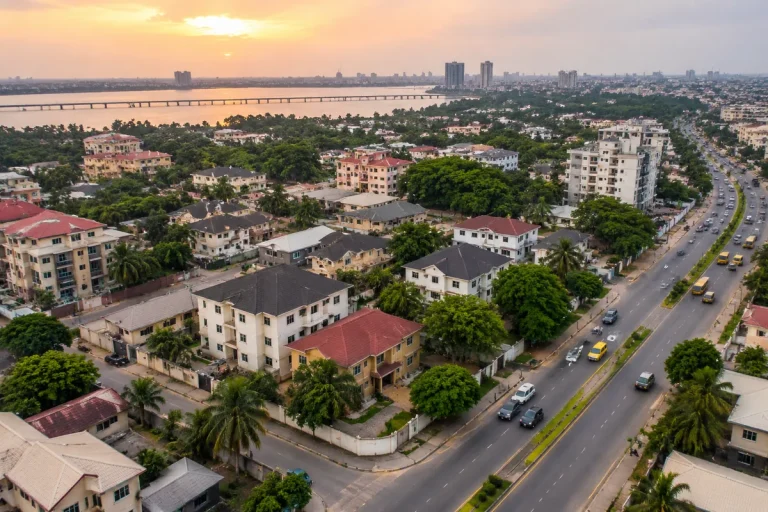
Planning a rent budget in Nigeria is harder than it looks because rent is often paid a year at a time while income arrives monthly. This guide gives you a simple method to see how much rent you can afford in naira, how to save toward the annual payment, and which extra costs people forget.
The numbers below are examples to show the method. Use your own income and real quotes.
Step 1: Know your real monthly income
Use the amount that actually reaches your account after tax and deductions. If your income varies, take the average of your lowest three months, not your best ones.

Step 2: Use a rent-to-income rule as a guide
A common rule of thumb is to keep rent at or below about 30 percent of your monthly income. Where yearly rent is paid up front, divide the annual rent by twelve to compare it fairly. For example, annual rent of ₦1,500,000 equals ₦125,000 a month. At a 30 percent target, that fits an income of about ₦416,000 a month. Our guide to rent versus income explains the idea in more detail.
Step 3: Add the costs that come with the rent
- Agent and legal fees (see rent advance and agent fees in Lagos)
- Caution or damage deposit, if any
- Power: prepaid electricity, and fuel for a generator or inverter where supply is unreliable
- Water, if it is not included, and waste or security levies
- Transport to work, which can change a lot with the area you choose
- Moving costs and basic items for the new home

Step 4: Build a savings plan for annual rent
If your rent is due in a lump sum, work backwards. Divide the amount you need by the months left. To have ₦1,500,000 in ten months, you need to put aside ₦150,000 each month. Open a separate savings account so the money is not spent, and consider setting up an automatic transfer on payday.
Step 5: Ask for a payment plan
Some landlords will accept two or four payments, particularly for tenants with steady jobs. Ask politely and offer proof of income. Compare the total, because instalments sometimes cost more. See also how to negotiate rent.
Watch out for borrowing traps
Quick loan apps can be expensive and some are scams. Before you borrow for rent, read whether you should borrow to pay rent and how to spot loan scams.
Quick budget template
- Monthly income after deductions
- Annual rent divided by 12
- Monthly share of fees and deposit
- Power, water, transport and food
- What is left for savings and emergencies
If step 5 leaves you with nothing, the rent is probably too high. Look at a smaller place, a roommate, or a different area.
How to cut your rent budget in Nigeria without moving far
A sensible rent budget in Nigeria is not only about finding the lowest price. It is about lowering the total cost of living where you rent. Consider a smaller flat, a shared apartment, or an area slightly further out with a reliable transport link. Compare the saving on rent with the extra transport cost and travel time. If a cheaper flat adds two hours of travel each day, you may lose more in time and fares than you save.
Plan for irregular income
Many people in Nigeria earn from business, commissions or several small jobs. If this is you, base your rent budget in Nigeria on your lowest recent months, not your best. Put a fixed amount into a rent savings account as soon as income arrives, and treat it like a bill. In good months, add extra. It is also wise to keep one to two months of rent as an emergency cushion so that a slow month does not put your home at risk.
Hidden costs to include in the budget
- Fuel or power backup: if the grid is unreliable, include generator fuel or inverter maintenance.
- Water: if you buy water or pay for a borehole share, add it.
- Repairs: keep a small monthly amount for small fixes.
- Renewal costs: when the year ends, rent may increase and agent or legal fees may repeat.
- Furniture and moving: these are one-time but real costs in your first month.
A worked example
Suppose your take-home pay is ₦450,000 a month. Thirty percent is ₦135,000, so a flat with yearly rent of about ₦1,620,000 is near your upper limit before fees. If agent and legal fees add ₦243,000, you need ₦1,863,000 at move-in. To save that in twelve months you would put aside about ₦155,000 each month, which is more than the monthly rent itself. That shows why many renters choose a lower rent or a payment plan. These numbers are only an illustration, so use your own figures.
Five steps to a rent budget that works
- Work out your real monthly take-home pay.
- Divide yearly rent by twelve to get the monthly equivalent.
- Add fees, power, water and transport.
- Compare the total with about 30 percent of your income as a guide.
- Set up an automatic saving for the annual payment.
Following these steps gives you a rent budget in Nigeria that you can really keep. For the fees side, see our guide to rent advance and agent fees in Lagos.
- A rent budget in Nigeria must compare yearly rent with monthly income.
- Include fees, power and transport in your rent budget in Nigeria.
- Save every month toward the annual payment in your rent budget in Nigeria.
- A good rent budget in Nigeria keeps a cushion for irregular income.
- Ask about instalments to make your rent budget in Nigeria easier to keep.
- Review your rent budget in Nigeria each time rent or income changes.
Frequently asked questions
Is the 30 percent rule right for everyone?
No. It is a starting point. If you have debts or dependants, aim lower.
Should I rent for a year if I can pay for two?
Paying more up front rarely saves enough to justify the risk. Keep a cash cushion.